
Blockchain Privacy Explained: Common Myths and Real Limits
posted by:
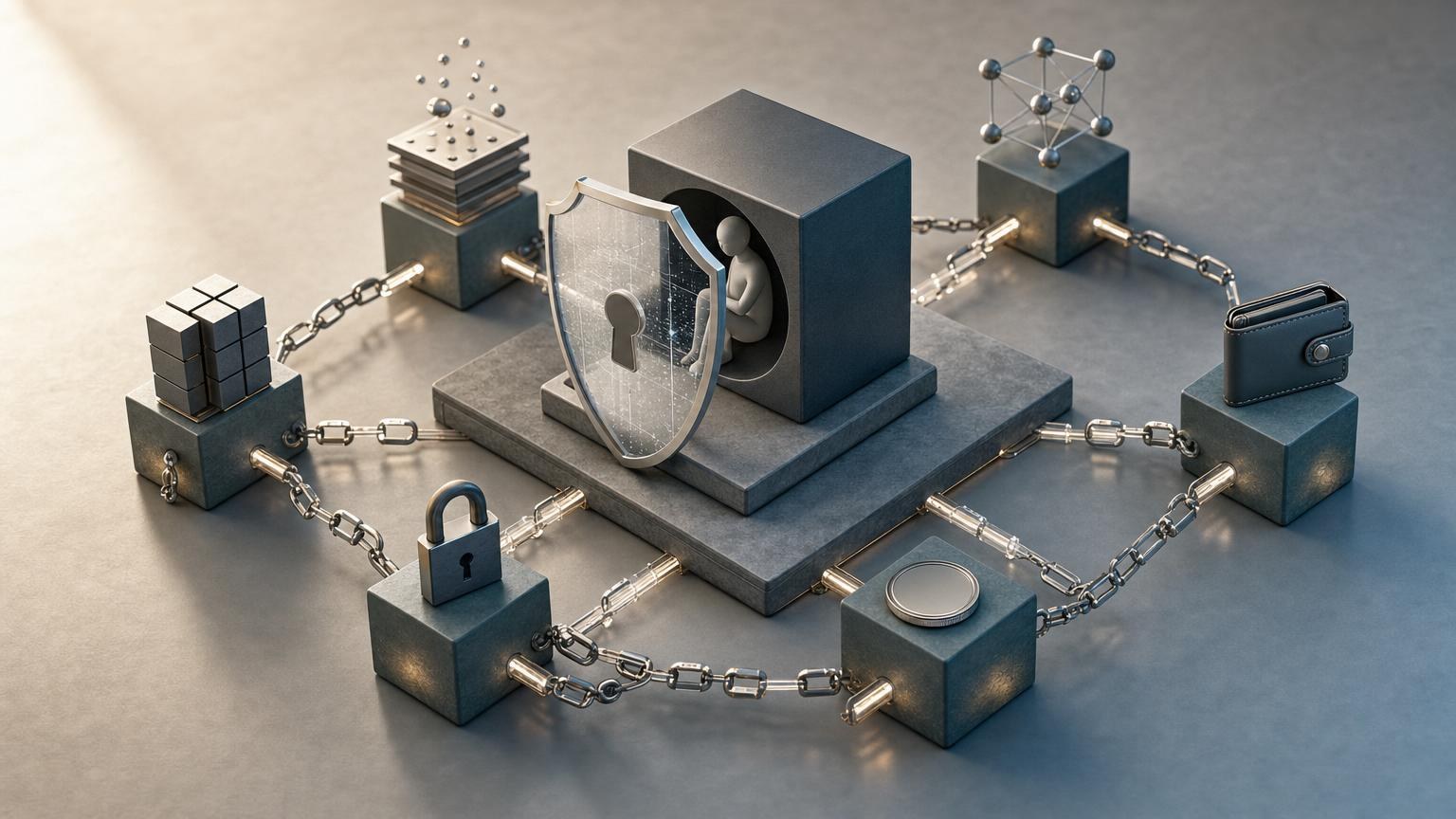
Blockchain privacy is neither complete anonymity nor a total absence of protection. On public networks, transactions are usually visible while the people behind addresses are not identified directly by the protocol. That separation can provide pseudonymity, but it becomes fragile when transaction patterns, wallet infrastructure, counterparties, or regulated services supply the missing context. Privacy-focused protocols can conceal more on-chain information, yet they still cannot erase data disclosed outside the blockchain or guarantee anonymity against every adversary.
This analysis covers transaction visibility, address linkage, network metadata, privacy-enhancing cryptography, and interactions with service providers. It does not assess the legal status of a particular transaction, identify individual wallet owners, or claim that every blockchain exposes the same data.
How the Claims Were Checked
Stable technical claims were compared with protocol documentation and project-maintained materials. Bitcoin’s original privacy model and current Bitcoin documentation were used for public-ledger and address-linkage questions; Ethereum documentation was used for account visibility, zero-knowledge applications, and RPC metadata; Monero materials were used for privacy-by-default mechanisms and their stated limitations. Regulatory claims were limited to FATF publications, while recognizing that FATF standards are implemented through national rules rather than functioning as one universal cryptocurrency law.
Freshness matters most for software behavior, protocol upgrades, compliance frameworks, and known analytical weaknesses. Accordingly, recent project documentation was preferred for those subjects. An old source remains useful when it defines a protocol’s original architecture, but it cannot establish that every modern wallet, service, or privacy tool behaves identically.
What a Public Blockchain Actually Reveals
Bitcoin was designed around publicly announced transactions rather than a confidential bank-style ledger. Its white paper describes privacy as keeping public keys separate from identities, while also warning that multi-input transactions and later identity disclosure can connect activity to a common owner. This is pseudonymity: the ledger records transactions without necessarily recording a legal name, but the separation can fail when additional information appears. [1]
Current Bitcoin guidance is similarly explicit that confirmed transactions are public and permanent. Addresses are not inherently names, but purchases, address reuse, counterparties, and other circumstances may create an identity link. Using a new receiving address can reduce simple reuse-based linkage, although it does not remove historical transaction relationships already recorded on the chain. [2]
Ethereum exposes an even broader application layer. Its official documentation states that addresses, balances, transactions, contract calls, and events can be inspected through the public ledger. Smart-contract activity may therefore disclose not just a transfer, but interactions with exchanges, lending protocols, token contracts, voting systems, games, or other applications. A pseudonymous address can become a persistent behavioral profile even when the protocol does not contain its owner’s name. [3]
Transparency has a functional purpose: independent nodes can verify state changes without trusting a private database operator. The same property creates the privacy trade-off. Once public transaction data is confirmed and retained by the network, later disclosure of an address owner can expose earlier activity associated with that address and potentially with related addresses.
Why “Anonymous Address” Is an Incomplete Description
An address is better understood as a technical identifier than as a private identity. The blockchain may not know who controls it, but other participants can collect that information. A merchant knows the address from which it was paid. A recipient knows which payment it received. A hosted wallet or exchange may associate addresses with an account. A public donation address can connect an organization or individual to every visible transfer involving that address.
Linkage can also arise from transaction structure. On a UTXO-based network such as Bitcoin, spending several outputs together may indicate common control, as the original privacy section of the white paper recognized. Such reasoning is generally heuristic rather than infallible: a pattern can support an inference without proving the legal identity of a user. [1]
Account-based networks produce different patterns. Repeated interactions from one Ethereum address make balances and application history easy to group. Creating another address does not necessarily break the connection if the old address funds it directly, both addresses interact in a distinctive sequence, or the same off-chain account and network connection are used.
This distinction prevents two opposite errors. Public records do not automatically reveal everyone’s civil identity, but the absence of a name in a block explorer does not make the activity untraceable.
Privacy Extends Beyond the Ledger
Wallets commonly obtain blockchain data through an RPC provider, node operator, explorer, or wallet backend. Ethereum documentation warns that these intermediaries may see requests together with metadata such as an IP address or location. Repeated balance checks can allow a provider to associate network metadata with the addresses being queried. Running a node can reduce dependence on a third-party data provider, but it introduces storage, bandwidth, maintenance, and operational requirements rather than creating automatic anonymity. [4]
Application infrastructure forms another layer. A website can have analytics, local storage, support records, cookies, or account logins. A zero-knowledge circuit may hide selected values while the frontend still observes a session, device, or IP address. Ethereum’s privacy-app guidance specifically cautions that using the same IP address, RPC provider, or session for actions intended to be unlinkable can weaken the privacy supplied by the proof. [3]
Counterparties remain relevant as well. Cryptography cannot force a merchant, payment recipient, messaging platform, or account provider to forget information voluntarily supplied by a user. Monero’s own FAQ makes this limitation explicit: providing a name and address to another party is not undone by using a private transaction protocol. [5]
What Privacy-Enhancing Cryptography Can and Cannot Do
Zero-knowledge proofs
A zero-knowledge proof can demonstrate that a statement is valid without revealing the underlying secret data. In blockchain applications, this may support private membership proofs, shielded balances, confidential voting, or selective disclosure. It does not mean that an entire transaction becomes invisible by default.
The privacy boundary depends on the circuit and the surrounding system. Public inputs, contract storage, emitted events, calldata, funding paths, fee payment, and submission metadata can remain visible. The size and composition of the anonymity set also matter: a technically correct proof provides limited practical concealment when very few users could have produced it. [3]
Privacy by default
Monero uses ring signatures, Ring Confidential Transactions, and stealth addresses to obscure the sender, amount, and recipient at the protocol level. Unlike optional shielded modes, its standard transactions are designed to apply privacy mechanisms by default. [5]
That stronger on-chain model still has limits. Key compromise, voluntary disclosure, identifiable exchange accounts, malware, timing information, and network observations can reveal facts outside the transaction cryptography. Research published by the Monero project in April 2025 also described a probabilistic timing weakness in the then-current decoy-selection model for users facing unusually strong adversaries. The finding did not show that every transaction could be deterministically traced; it showed that privacy guarantees depend on statistical assumptions and may require continuing protocol improvement. [6]
Selective disclosure
Privacy is not always equivalent to revealing nothing. Some systems allow a wallet holder to disclose a viewing capability, prove that a condition is satisfied, or reveal selected transaction information without publishing the entire history. This can improve auditability or compliance, but the result depends on what is shared, with whom, and whether the disclosed data can be copied or correlated with other records.
Claim Registry
| Claim | Verification status | Primary source type and name | Source publication or update date | Limitation | What could change the conclusion |
|---|---|---|---|---|---|
| Public blockchains are anonymous because addresses contain no names. | Contradicted as stated | Protocol paper: Bitcoin: A Peer-to-Peer Electronic Cash System; project documentation: Bitcoin privacy guidance and Ethereum privacy documentation. [1] | Bitcoin white paper: October 31, 2008; Ethereum privacy page: website updated July 16, 2026 | The exact information visible differs by protocol. Pseudonymity can survive when no reliable identity link or transaction linkage exists. | A protocol that conceals transaction data by default, a correctly used privacy layer, or new cryptographic designs could reduce public visibility. Identity disclosure could instead weaken privacy retroactively. |
| Using a new address for every transaction prevents activity from being linked. | Condition-dependent | Protocol paper: Bitcoin white paper; developer documentation: Bitcoin transaction guidance. [1] | Bitcoin white paper: October 31, 2008; developer page: no publication date displayed | Fresh addresses reduce direct address reuse but do not eliminate multi-input linkage, direct funding links, counterparty records, wallet fingerprinting, or network metadata. | Wallet coin-selection changes, collaborative transaction techniques, protocol upgrades, or more capable analytics could alter the practical strength of particular linkage methods. |
| A zero-knowledge proof makes every part of a blockchain interaction private. | Contradicted as a blanket claim | Project technical guidance: Ethereum Foundation article on building privacy applications with zero-knowledge proofs. [3] | Published May 12, 2026; page updated May 28, 2026 | The proof conceals only what the circuit and application are designed to conceal. Public inputs, contract data, funding, fees, sessions, and RPC metadata may remain exposed. | Application architecture, relaying methods, private fee mechanisms, larger anonymity sets, and changes to public inputs could materially improve or reduce privacy. |
| Monero guarantees complete anonymity regardless of user behavior. | Contradicted; stronger on-chain privacy is confirmed, an absolute guarantee is not | Project documentation: Monero FAQ; project research publication: OSPEAD ring-signature research. [5] | FAQ: no publication date displayed; OSPEAD article: April 5, 2025 | The protocol conceals core transaction fields, but endpoint compromise, voluntary disclosure, service records, timing analysis, and operational mistakes remain outside or partly outside that protection. | Protocol upgrades, improved decoy selection, new attacks, stronger endpoint protection, or additional empirical research could change the effectiveness of specific tracing methods. |
| A regulated or hosted service can never request identity or transaction information for a privacy-enhanced asset. | Contradicted as a universal claim | Intergovernmental standard-setting publication: FATF virtual-assets materials and 2025 targeted update. [7] | Targeted update published June 26, 2025 | FATF sets international standards, but countries implement them differently. A service’s requirements also depend on the transaction direction, risk assessment, applicable law, and compliance results. | National legislation, enforcement practice, service policies, risk controls, or later FATF publications could change the information requested in a particular case. |
| The real person behind any blockchain transaction can always be determined from on-chain data alone. | Unknown and case-specific | No universal primary source can establish this for every protocol, address, transaction, and adversary. Project sources instead document both visible data and unresolved privacy boundaries. [8] | Not applicable | Attribution may be an inference rather than proof. Its quality depends on available records, protocol design, user behavior, analytical methods, and access to off-chain information. | New evidence from a counterparty, service provider, seized device, wallet disclosure, protocol weakness, or improved analysis could strengthen or overturn an attribution. |
Practical Meaning for an Ordinary User
The useful question is not “Is this blockchain private?” but “Which information is hidden, from whom, and under what assumptions?” A public transfer may hide a legal name while exposing the amount and transaction graph. A privacy-oriented protocol may conceal those fields but leave exchange records or device metadata available. A zero-knowledge application may protect one action while an identifiable funding transaction connects the participating wallet to the user.
Privacy also depends on the threat model. Preventing casual acquaintances from viewing a complete balance is different from resisting a data broker, a service with customer records, malware on the device, or an investigator able to obtain records from several parties. No single wallet setting addresses all of these observers.
Users should distinguish four layers before a transaction:
- Ledger layer: which addresses, amounts, contracts, tokens, and transaction relationships become public?
- Network layer: who operates the RPC server, node, wallet backend, or relay, and what connection metadata can it observe?
- Application layer: does the wallet or website collect account, session, analytics, support, or device information?
- Counterparty and service layer: who knows the purpose of the payment, and can an exchange, merchant, or other provider connect it to an identified account?
A privacy feature should therefore be evaluated as one component of a system, not as a label attached to a coin or wallet.
Operational and Compliance Risks
Irreversibility: confirmed blockchain payments generally cannot be cancelled in the manner of a card chargeback. Bitcoin documentation advises verifying the recipient and transaction details because a refund normally depends on the recipient returning the funds. Privacy mechanisms do not correct an erroneous destination. [2]
Wrong address or network: an asset name alone may not identify the required blockchain network or deposit format. Sending through an unsupported network, copying a substituted address, or confusing similarly formatted destinations can result in loss or a difficult recovery process. The complete address, selected asset, selected network, and recipient instructions need to agree before signing.
Phishing and key theft: no privacy protocol protects funds after a seed phrase or private key is disclosed. Fake support agents, malicious wallet interfaces, address-replacement malware, and fraudulent exchange pages can bypass transaction privacy by taking control of the wallet or changing the intended recipient. Bitcoin’s scam guidance emphasizes checking the full receiving address and never giving a seed phrase or private key to a purported support representative. [9]
Volatility: privacy and market value are separate properties. An asset can have strong transaction-confidentiality features while its exchange value changes sharply. Privacy analysis should not be treated as a forecast of price, liquidity, or return.
Compliance differences: use of a self-custody wallet does not mean that every later service interaction will be document-free. FATF standards call for preventive measures and transmission of originator and beneficiary information in covered service-provider transfers, but implementation and enforcement differ among countries. Requirements may also vary according to the operation and the results of compliance checks. [7]
Procedure for Rechecking Dynamic Information
- Identify the exact asset, blockchain network, wallet version, privacy mode, and destination type. Similar product names may conceal materially different transaction paths.
- Read the current protocol and wallet documentation rather than relying on an old description of the asset. Check whether privacy is mandatory, optional, experimental, or limited to selected fields.
- Inspect what the transaction will publish: sender-related data, recipient data, amount, token contract, calldata, events, fees, and direct funding links.
- Review how the wallet connects to the network. Determine whether it uses a third-party RPC provider, its own node, a wallet backend, or another intermediary that may receive address queries and connection metadata.
- Check the recipient or service instructions immediately before sending. Confirm the supported asset, network, address format, required memo or tag, and any compliance conditions.
- Verify the legal and tax rules applicable to the relevant country through current official sources. International standards do not remove differences in national law.
- When feasible, use a suitably small initial transfer to detect an incorrect address, network, or destination configuration before committing a larger amount. This reduces operational exposure but does not make a transaction reversible or eliminate fees and compliance checks.
For an intended exchange, including one involving a privacy-oriented asset, the available direction and network should be confirmed immediately before creating a request. The service supports selected assets and adds new ones over time, but this does not establish that every pair, network, or direction is currently available. Verification requirements can depend on the operation and its compliance review. Use the current exchange-direction availability check as an operational step, not as evidence of blockchain anonymity or regulatory status.
You might also like
|
|
|
|
|